They're Redrawing the Map
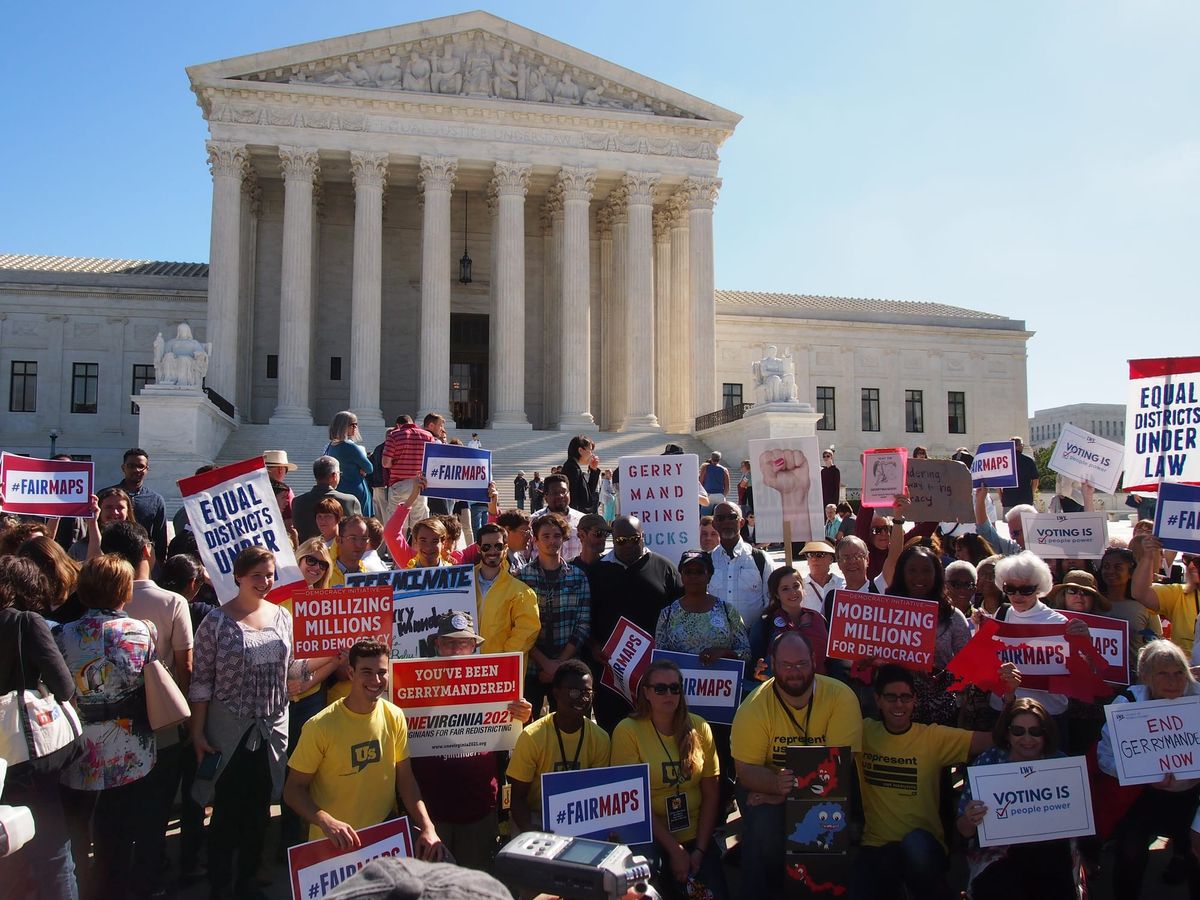
The Supreme Court just gutted a key section of the Voting Rights Act. Trump is already telling red states to redraw their congressional maps. Democrats could lose up to 19 House seats before a single vote is cast in November.
By The New Brief Politics Desk | May 5, 2026
There is a version of political corruption so brazen it almost dares you to call it what it is. This week, that version arrived in full.
The Supreme Court issued a ruling that significantly narrowed the scope of Section 2 of the Voting Rights Act — the provision that for decades has been the main legal tool for challenging racially discriminatory electoral maps. Under the Court's new standard, a state violates the law only if it can be proven that it intentionally drew districts to disadvantage minority voters because of their race. Proving intent, in a court of law, against a legislature that will never put that intent in writing, is extraordinarily difficult. For practical purposes, the ruling makes the Voting Rights Act far harder to enforce.
Within hours, President Trump had responded by name-checking Tennessee as the next state that should redraw its congressional map. Georgia's Republican governor announced he would review his state's maps. Louisiana, already embroiled in redistricting litigation, said it would delay its primary to accommodate new lines. The scramble was on.
"Democrats fear the ruling could hand Republicans as many as 19 new House seats — before a single ballot is cast in November's midterms."
What the Ruling Actually Does
The Voting Rights Act of 1965 was passed to dismantle the infrastructure of voter suppression that had kept Black Americans, particularly in the South, from participating in democracy. Section 2 was its enforcement engine — the provision that allowed courts to strike down maps that diluted the voting power of minority communities, even without direct evidence of intent.
For decades, courts applied a "results test": if a map produced outcomes that disadvantaged minority voters, that was enough to raise a Section 2 claim. The Supreme Court's new ruling moves the standard toward intent — a much higher bar that election law experts say will effectively insulate discriminatory maps from legal challenge.
"This takes us back to a pre-Voting Rights Act world in terms of what plaintiffs can actually prove," one voting rights attorney told The Hill. "Intent is almost impossible to establish when legislators know not to say the quiet part out loud."
Trump Is Saying the Quiet Part Out Loud Anyway
Except that the president is, in fact, saying the quiet part out loud. On social media and in public statements, Trump has been explicit that the goal of the redistricting push is to protect the Republican House majority heading into the 2026 midterms. He is not framing it as a good-government exercise in fair representation. He is framing it as a political strategy.
CNN reported that Trump has been pushing these changes specifically because he wants to prevent Democratic gains in the House — a majority Republicans currently hold by a razor-thin margin. The executive and legislative actions he has pushed since taking office, from voter ID requirements to eliminating mail ballots to demanding proof of citizenship, have all been pitched internally as midterm protection measures.
"The most powerful thing Trump has done is make the manipulation visible — and bet that enough people either approve of it or won't show up to stop it."
What It Means for November — and for You
Democrats estimate the combination of the Supreme Court ruling, aggressive redistricting in Southern states, and the other voting restriction measures could cost them as many as 19 House seats before a ballot is cast. In a chamber where the majority is already thin, that math is existential.
For young voters specifically, the combination of eliminated mail ballots and strict voter ID requirements is not incidental. It is targeted. Young people, students, and people who have recently moved — all groups that skew Democratic — are statistically more likely to lack the specific documents now being required and more likely to rely on mail voting for convenience. These rules don't affect every voter equally. That is the point.
The midterms are in November. Voter registration deadlines in most states fall between October and early November. If you are not registered, or if you are registered at an old address, now is the time to fix it — not because it feels urgent yet, but because by the time it feels urgent, it will be too late.
— The New Brief | May 5, 2026 —